
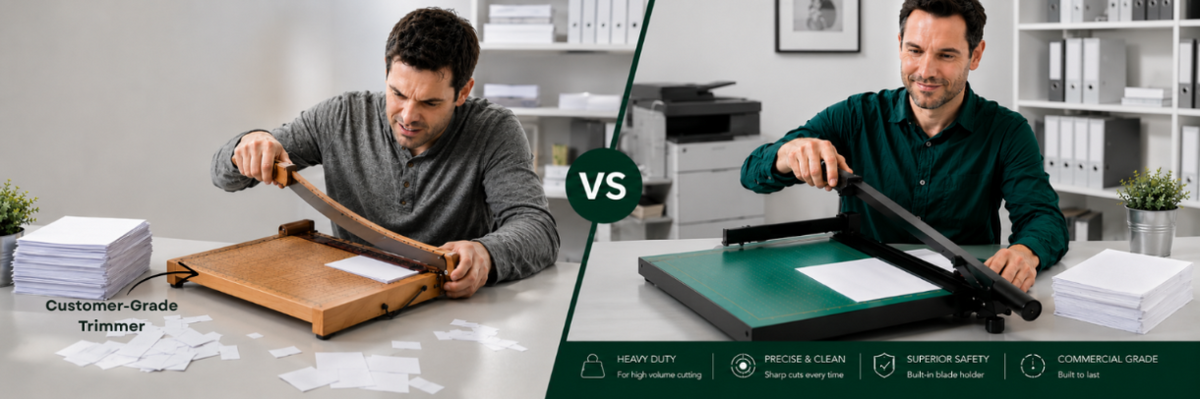
A professional paper trimmer is not simply a more expensive version of what sits on a craft table. The differences run through blade steel, base construction, sheet capacity, and safety engineering, and each one has a direct impact on cut quality and daily reliability. Print shops, schools, offices, and home users who trim paper regularly cannot afford the inconsistency that comes with equipment designed for occasional light use.
The wrong trimmer produces slanted edges, misaligned stacks, and blades that dull faster than they should. Understanding what drives those problems, and what solves them, is what this post covers, from how guillotine paper trimmers work to safety features, maintenance, and what to look for when choosing the right model.
How Consumer-Grade Paper Trimmers Are Built Differently
Consumer trimmers are designed around a different set of priorities: low manufacturing cost, light portability, and occasional single-sheet use. That is a legitimate product category. The problem arises when those trimmers get pushed into daily office or finishing work.
What That Means for Output Quality and Daily Use
The construction differences produce specific, predictable problems:
- Thin or non-rigid bases flex under pressure, causing the blade angle to shift mid-cut. The result is a slanted edge rather than a square one, even when the paper is aligned correctly.
- Soft blades that are not hardened drag through paper rather than shearing it cleanly. Dragging tears the edge of the bottom sheets in a stack, particularly on coated or heavier stock.
- No paper clamp means stacks shift during the cut. Above 5 sheets, alignment errors compound and the trimmed edge migrates from the intended cut line.
- Printed alignment grids wear off with use. A ruler that fades after a few months is no longer a reference; it is a source of measurement error.
- Low sheet capacity makes batch work slow and impractical. Trimming 10 sheets at a time on a machine rated for 5 produces blade stress and inconsistent cuts.
These are not edge cases. They are the predictable result of using a trimmer beyond what it was designed to do.
How a Guillotine Paper Trimmer Works and Why the Mechanism Matters
A guillotine paper trimmer uses a single arm-mounted blade that descends in a fixed arc against a stationary base, cutting through a stack in one controlled motion. The quality of that cut depends entirely on two things staying consistent throughout: the base not flexing and the blade holding its angle.
- Single descending blade travels the full cut length in one motion, producing a straight edge across the entire stack
- Stationary base absorbs the cutting force without shifting, which is what keeps the cut square
- Blade tension and angle determine edge quality; both stay consistent when the base and blade are built to hold their position
- Rotary vs guillotine rotary trimmers use a wheel along a rail and are better suited to single sheets and light stock. Guillotine trimmers handle stacked cutting and heavier materials better
What Martin Yale Professional Paper Trimmers Are Built to Handle
Martin Yale paper trimmers address each of those failure points through construction choices that hold up under daily use and higher sheet volumes.
- Hardened or precision-angle steel blades that maintain a consistent shear angle across the full cut length, producing clean edges on paper, cardboard, matte board, film, tissue, and textiles
- 3/4 inch thick wood base (GreenBoard and StakCut series) that keeps the cutting surface stable so the blade descends at a consistent angle regardless of stack thickness
- Unbreakable molded base (PolyBoard series) built from high-density polystyrene for durability without the weight of a wood-base model
- Hand-operated paper clamps that hold stacks firmly in position before and during the cut, preventing shift on stacks up to 30 sheets
- Permanent imprinted alignment grids with dual English and metric rulers that stay readable through years of daily use
- Self-sharpening blade mechanics, where the blade edge sharpens against the base plate with each cutting motion, maintaining performance without manual intervention
Higher sheet capacity means fewer passes to complete the same job. That reduction compounds quickly in batch work, where cut consistency matters as much as speed.
Safety Features That Separate Professional Paper Trimmers From Consumer Options
A guillotine blade is under spring tension and travels in a fast, fixed arc. The safety features on a professional paper trimmer are not accessories; they are what makes daily use practical without risk of injury.
The features that matter most in practice:
- Patented automatic blade latch that locks with every cutting motion, preventing the blade from releasing unintentionally between cuts
- Finger guard covering the full blade length throughout the cutting stroke, keeping hands clear of the blade path at all times
- Torsion spring that holds the blade securely in the raised position and prevents it from dropping accidentally when the trimmer is not in use
- Non-skid rubber feet that prevent the base from moving on the work surface during a cut, which is particularly important on larger, heavier models
Most trimmer injuries happen when a blade falls or releases while paper is being positioned. The latch and torsion spring exist specifically to prevent that, and on Martin Yale trimmers they engage automatically with every cut.
Keeping a Professional Paper Trimmer in Working Condition
Proper maintenance is straightforward and takes little time. The self-sharpening mechanism does most of the work automatically. A few practices extend blade life and cut quality significantly.
- Clean the blade regularly, particularly after cutting coated stock or adhesive-backed materials. Residue build-up on the blade surface increases drag and affects edge quality.
- Check the base surface for scoring over time. Deep grooves from repeated cuts in the same position can interfere with alignment. Rotating the trimmer position slightly during batch work distributes wear.
- Inspect the blade latch periodically. A latch that does not click firmly with every cut motion should be checked before continued use.
- Store the trimmer with the blade latched and lowered. Extended storage with the blade under spring tension in the raised position can affect the torsion spring over time.
A trimmer that is cleaned after heavy use and stored correctly holds its cut quality far longer. That consistency is the point of buying professional equipment in the first place.
Martin Yale Premier Paper Trimmers for Offices, Print Shops, and Schools
The Premier Paper Trimmers lineup covers cutting lengths from 12 to 36.5 inch, built across three series, each designed for a distinct combination of workload, material type, and environment. The four models below represent the range from desk-ready daily use to large-format heavy-duty finishing work.
- Martin Yale Premier PolyBoard P215X Paper Trimmer: Unbreakable molded base with a self-sharpening hardened steel blade, 10-sheet capacity, and a 15 inch cutting length. Built for schools, offices, quick print shops, and mailrooms handling regular light-to-medium daily trimming.
- Martin Yale Premier StakCut 724 Paper Trimmer: Precision-angle steel blade on a heavy wood base, 30-sheet stack capacity, and a 24 inch cutting length with a hand-operated paper clamp. Suited to medium-to-heavy-duty batch cutting in offices and print environments.
- Martin Yale Premier GreenBoard W30 Paper Trimmer: Precision-angle steel blade with a 30 inch cutting length, 20-sheet capacity, and a hand-operated clamp on a heavy wood base. Designed for larger format finishing tasks in offices, schools, and print shops.
- Martin Yale GreenBoard WC36 Heavy-Duty Paper Trimmer: The largest model in the GreenBoard series, with a 36.5 inch cutting length and 20-sheet capacity on a heavy wood base built for maximum stability. For large-scale trimming of oversized sheets, flyers, cardboard, and wide-format printed materials.

The Right Paper Trimmer Is Built for the Work, Not Just the Price
The gap between consumer and professional guillotine paper trimmers is not primarily about price. It is about what the trimmer is engineered to do consistently over time. Blade hardness, base rigidity, clamp design, and safety engineering all exist to solve specific problems that show up the moment trimming becomes part of a daily workflow rather than an occasional task.
The right paper trimmer is the one sized for the work being done. Cutting length, sheet capacity, and base type all narrow the decision down quickly. Getting those three things right means the trimmer performs consistently from day one.
Need Expert Guidance on Selecting the Right Paper Trimmer?
Selecting the right trimmer model depends on cutting length, daily volume, and the materials being trimmed. Contact the expert team, call (800) 992-5279, or email to discuss the right fit. The team will help match the correct model to the workload and environment.